A driver hands over a signed delivery docket, a picking list is replaced after an order changes, and paperwork from a damaged shipment is passed to the transport office. By the end of the shift, documents have moved between several people, and some are no longer needed.
The problem is that routine warehouse paperwork often contains information that should remain confidential. Customer addresses, supplier pricing, employee details and internal stock figures can all appear on documents used throughout the day.
Once these records are no longer required and have been approved for disposal, secure document shredding helps prevent sensitive information from ending up in the wrong hands.

Which Warehouse Records Need a Closer Look?
It depends on what information is on the page. A stock checklist showing pallet quantities may contain little sensitive information, while a delivery document with customer details or agreed prices needs more careful handling.
Common examples include:
- Delivery dockets and proof-of-delivery records: Customer names, addresses, contact numbers, signatures and order references.
- Picking lists and dispatch paperwork: Order details, delivery instructions and information about individual customers.
- Returns and damaged goods reports: Customer account details, claims, order values and correspondence about disputed deliveries.
- Supplier and stock records: Purchase orders, negotiated prices, inventory valuations and reports concerning missing or damaged stock.
- Employee and contractor paperwork: Payroll information, personnel records and workplace incident reports.
Some of these documents contain personal data. Others hold commercially sensitive information that a business would not want competitors, customers or unauthorised individuals to see.
Even a working copy can matter. An outdated picking list may no longer be useful to the dispatch team, but it could still contain the same customer information as the replacement.
Where Does Confidential Paper Get Left Behind?
The warehouse office is only one place to check. Paperwork is also used at goods-in desks, dispatch stations, shared printers and loading areas. A delivery docket might be put aside while staff deal with another vehicle. An amended order could leave two or three printed versions on the same desk.
Then the next shift arrives.
Without a clear system, the evening team may find documents left by the morning staff without knowing which ones are still needed. Paper can also collect in drawers or cardboard boxes, particularly when employees are unsure where to put it.
It is worth walking through the site and looking at how paperwork is actually handled. Where do staff print documents? Which desks tend to accumulate old forms? Is there somewhere secure to put confidential paper when it is no longer needed?
Ordinary recycling bins are fine for suitable packaging waste, but they are not the right destination for documents containing sensitive information.
Check Retention Requirements Before Shredding
Finishing a delivery does not necessarily mean the associated paperwork can be destroyed.
A signed docket might still be needed to resolve an invoice dispute. Finance may require supplier invoices for several years, while an incident report could need to be retained for legal or insurance reasons.
Before disposing of records, the department responsible should confirm that the relevant document retention requirements have been met.
The Data Protection Commission also makes clear that personal data should not be kept longer than necessary, although legal obligations may require certain information to be retained.
For a warehouse handling large volumes of paperwork, it helps to distinguish between documents awaiting review and those already approved for destruction.
That way, a box of old delivery records can be checked by the appropriate department without holding up the disposal of unrelated paperwork. Anything connected with an ongoing dispute or investigation should remain securely stored until its retention requirements have been resolved.

Make Confidential Shredding Practical for Every Shift
A procedure that works well for administration staff may be inconvenient for someone working at the far end of a large warehouse.
If the only confidential waste container is in the main office, employees may leave unwanted paperwork beside their workstation instead. Over time, those small piles become harder to control.
Having secure shredding containers in suitable locations gives staff a place to deposit documents that have already been cleared for destruction. Collection points should be convenient without obstructing forklift routes, loading areas or other working spaces.
Everyone handling confidential paperwork needs to understand the arrangement. That includes temporary and agency staff who may be covering different shifts.
There should also be a clear distinction between paper ready for shredding and records still awaiting approval. A box placed beside a collection point should never be mistaken for material that has already been authorised for destruction.

Arranging Secure Shredding for Your Warehouse
A distribution centre processing hundreds of orders each day may have very different shredding requirements from a smaller warehouse where most records are digital.
For sites producing confidential paperwork regularly, our scheduled shredding service provides ongoing collections. We supply locked consoles for office areas and confidential wheelie bins suited to warehouse and storage environments.
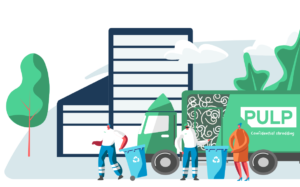
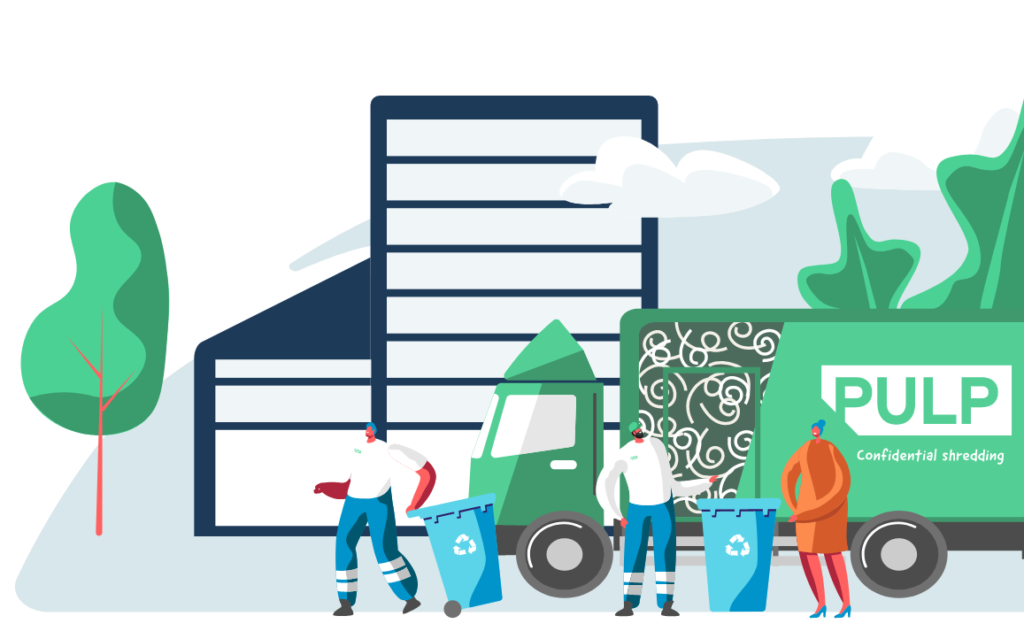
The paper is destroyed at your premises using our mobile shredding trucks, with the shredded material taken away for recycling.
Other businesses may only need a collection after clearing an archive or reviewing old records. If a larger quantity of paperwork has accumulated and is ready for destruction, our one off shredding service can deal with it without an ongoing collection commitment.
We also provide Certificates of Destruction as confirmation that confidential material has been securely destroyed. For paper shredding, certificates may be issued after individual visits or periodically, depending on the arrangement.
Pulp provides secure onsite shredding to warehouses and distribution centres throughout the Republic of Ireland.
If your business needs to dispose of confidential paperwork, get in touch. Let us know roughly how much paper you have and whether you need regular collections or a once-off service, and we can help arrange a suitable solution.